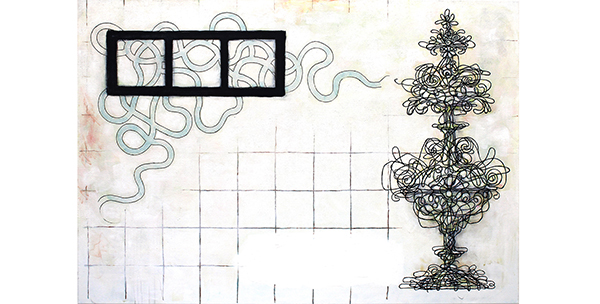
Tuoksut – Fragrances, 2026
.
STILLEBEN – Paintings, Gallery Longa, Helsinki 2026
For most of my career as a painter, I have made works that emerge from classical European architecture.
In recent years, however, I have become very interested in historical Japanese culture and architecture. I have studied a little Japanese language and Japanese culture. I have also tried calligraphy at the calligraphy evenings of the Friends of Japanese Culture Association.
In addition, these paintings have been influenced by my trip to China a long time ago. At that time, a local artist in Nanjing taught me Chinese ink and water color painting for a couple of weeks. He explained them like this: In a painting there must be empty and full, dark and light, dry and wet, thin and thick.
These new works of mine are a synthesis of the above. They combine classic European elements (five o’clock tea, fountains, etc.) with a kind of airiness and contrasting treatment of elements in Japanese and Chinese painting and calligraphy.
I have built the light base of the paintings from dark to light, so the light base is also very vivid. These are oil paintings, and even the thin lines are painted with a brush.
.
HOKUSAI’S SEA, MAHAL’S PEARLS – Paintings of Japanese symbols and Maharadjas’ Palaces, Gallery A2, Helsinki 2024
Perhaps the most famous Japanese artwork is Katsushika Hokusai’s woodblock print ”The Great Wave of Kanagawa”, known in the West simply as ”The Great Wave”. This powerful piece reflects the classical Japanese relationship with nature, highlighting the smallness of humanity in the face of natural forces.
In the culture surrounded by the sea, the role of water is evident in many aspects, such as fishing, rice cultivation, hot springs and bath culture. Water is also an important element in Japanese gardens. The culture of isolated island nation has developed its own unique path. Japan features fascinating cultural traits, symbols, concepts and customs that are not found elsewhere.
Taj Mahal, on the other hand, is India’s most famous building. The Great Mughal Shah Jahan built it in the 17th centure as a tomb monument for his beloved wife Mumtaz Mahal. It has been called the world’s most renowned architectural treasure.
The same motifs from Taj Mahal’s facade – but in more diverse and intriguin manner – were used in the Agra Fort, located 2,5 km away, where Shah Jahan was imprisoned during the last years of his life after his son seized power. The beautiful Mumtaz also lived in the same fort during her lifetime.
– – –
I have long been interested in Japanese culture, read related literature and even studied Japanese a little. – The India-themed works, on the other hand, originated quite spontaneously, inspired by a short tour of India at the beginning of 2024.
.